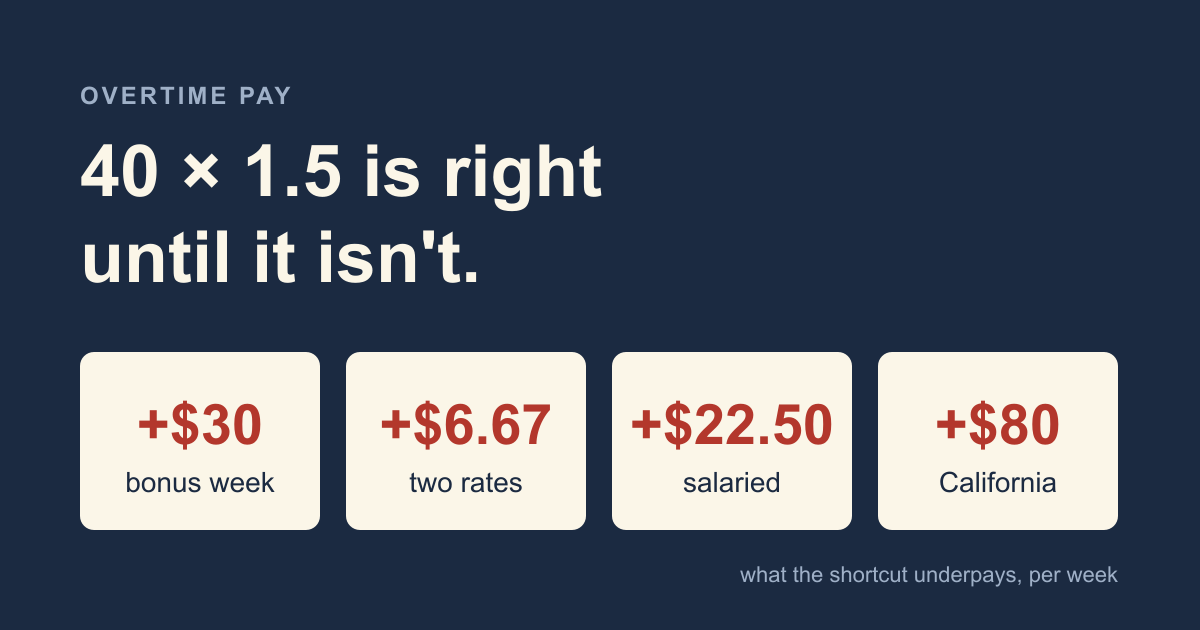
The formula breaks in four ordinary situations: a bonus, two rates of pay in one week, a salary that isn't exempt, and a state that counts overtime by the day. Each one is common, and in each the simple formula pays less than the law requires. Below is the calculation done properly, then each of the four, worked through with real numbers. Every rule here comes from the Department of Labor, a state labor department or a state statute, and the sources are listed at the end.
The basic calculation
Under the federal Fair Labor Standards Act, a non-exempt employee is owed at least one and a half times their regular rate for every hour over 40 in a workweek. Take someone paid $18 an hour who works 46 hours:
| Step | Working | Amount |
|---|---|---|
| Regular hours | 40 × $18 | $720.00 |
| Overtime hours | 6 × $27 (that's $18 × 1.5) | $162.00 |
| Week's pay | $882.00 |
There's a second way to get the same answer, and it's the one worth learning. Pay every hour at the straight rate, then add a half-time premium for each overtime hour: 46 × $18 = $828, plus 6 × $9 = $54, makes $882. Same number. But this is how the Department of Labor itself works overtime out, because it still gives the right answer once the rate stops being a single number. Every case below uses it.
First, count the right hours
Overtime is judged one workweek at a time. The Department of Labor defines a workweek as "a fixed and regularly recurring period of 168 hours", seven days in a row, and its overtime fact sheet is blunt: "Averaging of hours over two or more weeks is not permitted."
That matters most to anyone paid every two weeks. Work 50 hours one week and 30 the next and you've worked 80 hours in the pay period, which looks like no overtime at all. It isn't. The first week has 10 overtime hours, and at $18 an hour that's $90 owed on top of straight pay. The biweekly time card totals each week on its own line for exactly this reason.
The hours themselves need care too. A shift from 8:52 to 5:33 with a 30-minute lunch is 8 hours 11 minutes, and 8 hours 11 minutes is 8.18 hours in decimal, not 8.11. Payroll systems want the decimal; mixing the two up is how a week of small errors becomes a real one. The time card calculator and the time to decimal converter do that part.
1. A bonus raises the overtime rate
Production bonuses, attendance bonuses, safety bonuses, anything promised in advance or paid by a formula: the Department of Labor calls these nondiscretionary, and they count as part of the regular rate. So the overtime rate goes up in a week with a bonus, and the bonus has to be shared across the overtime hours too.
The Department's own example (Fact Sheet #56C): $10 an hour, 43 hours, a promised $50 bonus.
| Step | Working | Amount |
|---|---|---|
| Straight-time pay plus bonus | 43 × $10 + $50 | $480.00 |
| Regular rate | $480 ÷ 43 hours | $11.16 |
| Overtime premium | 3 hours × ($11.16 ÷ 2) | $16.74 |
| Week's pay | $496.74 |
Work it the simple way, 40 × $10 plus 3 × $15 plus the $50, and you get $495, which is $1.74 short. Small here. But scale it: $20 an hour, 50 hours, a $300 production bonus. Done properly that's $1,300 ÷ 50 = a $26 regular rate, plus 10 × $13 = $130, for $1,430. Done the simple way it's $1,400. Thirty dollars a week, every bonus week.
A bonus that's truly discretionary (the employer decides at the end whether to pay it and how much, with nothing promised beforehand) stays out of the regular rate. And a bonus that covers a month or a quarter is spread back over the weeks it was earned, with the extra half-time paid on each week's overtime once the bonus is known.
2. Two jobs at two rates in one week
Plenty of people work two roles for one employer: register and stockroom, aide and driver, days and nights at different rates. In that week the regular rate is neither of the two rates. It's their weighted average, which the regulation spells out: add up everything earned at all the rates and divide by all the hours.
Say 30 hours as a cashier at $20 and 15 hours in the stockroom at $16, 45 hours in all:
| Step | Working | Amount |
|---|---|---|
| Straight-time pay | 30 × $20 + 15 × $16 | $840.00 |
| Regular rate | $840 ÷ 45 hours | $18.67 |
| Overtime premium | 5 hours × ($18.67 ÷ 2) | $46.67 |
| Week's pay | $886.67 |
Paying the five overtime hours at time and a half of the stockroom rate, because those happened to be the last hours of the week, comes to $880: $6.67 short. There's one lawful alternative: if the employee agreed before the work was done, overtime can be paid at one and a half times the rate of the job actually being done in the overtime hours. Without that agreement, it's the average.
A shift differential works the same way. Extra pay for nights or weekends is part of the regular rate, so it lifts the overtime rate in the weeks it's paid. The time card with overtime and pay takes two rates and a differential in the same week and does this averaging for you.
3. "Salaried" doesn't mean "no overtime"
Being paid a salary and being exempt from overtime are two different things. To be exempt under the federal rules, a job has to pass a duties test (genuinely executive, administrative or professional work) and pay at least $684 a week. That's the level the Department of Labor has enforced since a federal court struck down the 2024 increase in November 2024. A salaried receptionist on $600 a week is owed overtime like anyone on an hourly wage.
For a salaried employee who isn't exempt, the regular rate is the salary divided by the hours the salary is meant to cover. The Department's example: $405 a week for a 45-hour schedule is a $9.00 regular rate. The five hours over 40 are then owed the half-time premium on top: 5 × $4.50 = $22.50, making $427.50 for the week. A fixed salary "for a regular workweek longer than 40 hours does not discharge" the overtime owed.
4. Your state may count by the day
Federal law only looks at the week. Four states also look at the day, and where state law gives more, the employee gets the more generous rule.
| State | Daily rule |
|---|---|
| California | Time and a half over 8 hours in a workday, double time over 12. On the seventh day worked in a row in a workweek, time and a half for the first 8 hours and double time after that. |
| Alaska | Time and a half over 8 hours in a day, for employers with four or more employees. Hours already paid as daily overtime aren't counted again toward the weekly 40. |
| Colorado | Time and a half over 12 hours in a workday, or over 12 consecutive hours however the shifts fall, as well as over 40 in the week. |
| Nevada | Time and a half over 8 hours in a workday, but only for employees paid less than one and a half times the state minimum wage. Four 10-hour days by mutual agreement are the exception. |
The day rule can create overtime in a week that has none federally. Four 10-hour days in California is 40 hours, so no federal overtime, but each day has 2 hours past 8. At $20 an hour that's 8 hours of daily overtime and $80 more than the straight $800, unless the workplace has voted in a lawful alternative workweek schedule.
Double time
Federal law has no double time at all. It comes from California's daily rule, above, or from a union contract or an employer's own policy, such as double time on holidays. A 13-hour day in California at $20 an hour is 8 hours at $20, 4 at $30 and 1 at $40: $160 + $120 + $40 = $320. The time card calculators here have a California 8/12 rule that splits the day this way, and an "over 8 a day, 40 a week" rule close to Alaska's and Nevada's. Colorado's 12-hour rule isn't one of the presets yet; count those days by hand.
What doesn't change the answer
Three things people hear that don't hold up. "Nobody approved that overtime" doesn't matter: if the employer "requires or permits" the work, it's owed, and the fix for unwanted overtime is a rule against working it, not keeping the pay. Time off later instead of overtime pay now is something only public employers can offer; a private employer has to pay. And no agreement, signed or not, can waive overtime under the federal law.
Checking a paycheck, step by step
- Total the hours for each workweek separately, from the actual punches.
- If you're in California, Alaska, Colorado or Nevada, mark the daily overtime first.
- Add up everything earned that week at straight time: every rate, every differential, every promised bonus.
- Divide by the week's total hours. That's the regular rate.
- Multiply half the regular rate by the overtime hours, and add it on (use the full regular rate for double-time hours).
- Compare with the pay stub. If the two differ, the four cases above are the first places to look.
If it still looks wrong after that, ask payroll to show you the regular rate they used. The Department of Labor's Wage and Hour Division also takes questions, free, at 1-866-487-9243. This page explains the general rules; it isn't legal advice for a particular job.
Our honest advice: learn the half-time method and forget the other one. "Hours over 40 times 1.5 times the rate" is a shortcut that only works when there's one rate and nothing else in the week. The half-time method is the actual rule. Check one pay stub with it and you'll never trust the shortcut again.
Sources
- U.S. Department of Labor, Fact Sheet #23: Overtime Pay Requirements of the FLSA (workweek, no averaging, salaried non-exempt example, "requires or permits").
- U.S. Department of Labor, Fact Sheet #56C: Bonuses under the FLSA (the $10, 43-hour, $50 example).
- 29 CFR 778.115 (two or more rates: weighted average), 778.209 (bonuses covering more than a week), 778.419 (rate in effect, by prior agreement), 778.207 (shift differentials); 29 U.S.C. 207(o) (comp time, public agencies).
- California Labor Commissioner, Overtime FAQ.
- Colorado Department of Labor and Employment, COMPS Order poster, Rule 4.
- Alaska Statutes 23.10.060; Nevada Revised Statutes 608.018.